

Resigning from a Swiss board: steps, register, liability
—12 min read

A member resigns from the board of a Swiss AG by declaring the resignation to the board, in practice in writing, naming the date it should take effect, and then making sure the commercial register entry is deleted; if the company does not file it, the departed member may file the deletion personally (Art. 933 para. 2 CO). Liability for decisions taken while in office does not end with the resignation.
What does Swiss law say about resigning, and what does it leave open?
The CO regulates how directors are elected and removed, but not how they leave on their own initiative. The general meeting elects the board and can remove anyone it elected (Art. 705 CO); a resignation is the mirror image that the law does not spell out. The table separates what is written down from what needs legal advice.
| Topic | Legal position (as of October 2026) |
|---|---|
| Removal by the general meeting | Possible for anyone the GV elected; compensation claims are reserved (Art. 705 CO) |
| Term of office | Listed companies: ends at the latest at the next ordinary GV. Unlisted: three years unless the articles say otherwise, six years at most (Art. 710 CO) |
| Resignation | No specific article. When it takes effect and whether an untimely resignation triggers damages is not stated in company law |
| Mandate rule | Art. 404 CO lets either party end a mandate at any time but makes the party who withdraws at an inopportune time liable for the damage. Whether it applies to a board seat is a question for a lawyer |
| Commercial register | Every change of a registered fact must be registered; the departed person may file the deletion (Art. 933 CO, Art. 17 para. 2 lit. a HRegV) |
| Representation | The company must be represented by a person resident in Switzerland who is a director or manager and, since 1 October 2026, has access to the share register (Art. 718 para. 4 CO) |
| Liability afterwards | Claims are time-barred three years after knowledge of the damage and the liable person, at the latest ten years after the harmful conduct (Art. 760 CO) |
When should the resignation take effect?
Because the law sets no rule, the resignation letter should say exactly when it takes effect. Three options are common: with immediate effect, on a fixed date, or at the end of the next general meeting. The right choice depends on what the company needs and what you need.
| Situation | Date to consider | Why |
|---|---|---|
| Ordinary departure, no conflict | End of the next general meeting | The GV can elect a successor and the board stays complete |
| Personal reasons, board stays functional | Fixed date a few weeks ahead | Gives the board time to arrange signing rights and the register filing |
| Serious disagreement with a decision | Immediately, with reasons on record | Ends your involvement in further decisions; record your dissent first |
| You are the only Swiss-resident signatory | Only after a replacement is registered | Leaving earlier can create an organisational defect (Art. 718 para. 4 and Art. 731b CO) |
| Company in financial difficulty | Take legal advice before deciding | Resigning does not remove duties already triggered, such as those under Art. 725 CO |
Whatever date you choose, it should be one the company can act on. A resignation dated before the letter arrives creates confusion in the minutes and the register.
Which steps make a clean resignation, and who does what?
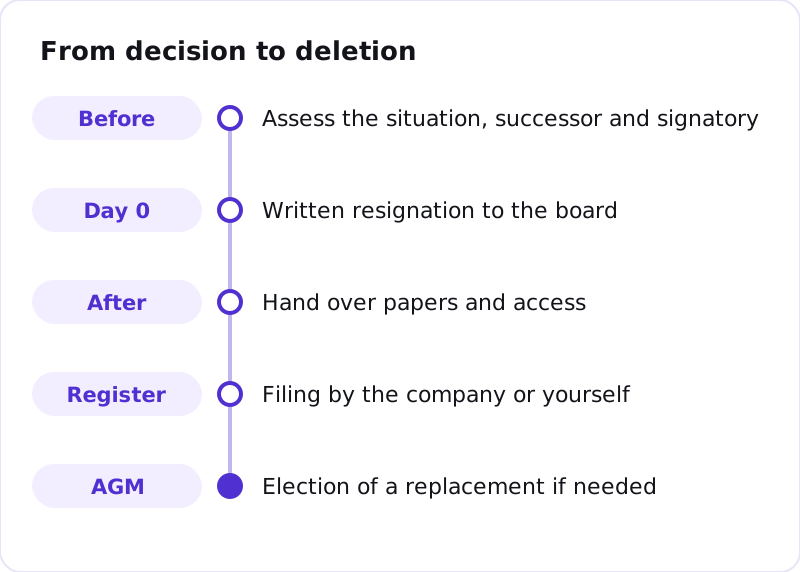
| Step | Owner | Timing |
|---|---|---|
| 1. Raise open matters and conflicts in the board | Departing director | Before the letter |
| 2. Check who can still represent the company and who meets the residence rule | Chair with the board office | Before the letter |
| 3. Send the written resignation to the chair and the company, with the effective date | Departing director | Day 0 |
| 4. Record the resignation and any reasons in the minutes | Board office | Next meeting or by circular note |
| 5. Hand over papers, devices, access and open action items | Departing director, board office | By the effective date |
| 6. File the deletion with the commercial register | Company (signatories) | After the effective date |
| 7. If the company does not file, file the deletion yourself | Departed director | After a reasonable wait |
| 8. Propose a successor to the general meeting | Board, nomination committee if any | Next ordinary or extraordinary GV |
Sample resignation letter
The following wording is a starting point, not legal advice: «To the board of directors of Muster AG, attn. the chair. I hereby resign as a member of the board of directors of Muster AG with effect from [date]. I ask the company to file the deletion of my entry, including my signing authority, with the commercial register promptly after that date and to send me a copy of the filing. I will return all board documents and devices by [date]. [Optional: My reasons are set out in the attached note, which I ask to be recorded in the minutes.] [Place, date, signature]»
Send the letter in a way you can prove later, for example by registered mail or by email with a confirmation of receipt from the chair. Keep a copy.
How do you get deleted from the commercial register?
The company must register every change to a registered fact, and a departure is such a change (Art. 933 para. 1 CO). Normally the board office prepares the filing and the remaining signatories sign it. If that does not happen, the departed person may file the deletion of their own entry, including the deletion of signing authority (Art. 933 para. 2 CO and Art. 17 para. 2 lit. a HRegV).
Ask the cantonal commercial register office which proof of the departure it requires with a filing you make yourself; a copy of the resignation letter and proof that the company received it are the obvious documents to keep ready. Then check the published entry in the cantonal register or in the Swiss Official Gazette of Commerce (SOGC).
Does liability depend on the register entry?
In a case on unpaid social security contributions under Art. 52 AHVG, the Federal Supreme Court held that a director's responsibility generally lasts until the actual departure from the board, not until the deletion in the register; the exception is damage from acts whose effects only unfold after the resignation (BGE 126 V 61, consideration 4). Even so, a stale entry still tells third parties that you are on the board, so push for the deletion and keep your proof.
Does liability end with the resignation?
No. Under Art. 754 CO, directors are liable to the company, shareholders and creditors for damage they cause by breaching their duties intentionally or negligently, and that attaches to conduct during the term. Claims are time-barred three years after the injured party learns of the damage and the liable person, and at the latest ten years after the harmful conduct (Art. 760 para. 1 CO); if the conduct was a criminal offence, the longer criminal limitation period can apply (Art. 760 para. 2 CO).
A discharge resolution of the general meeting helps only for facts that were disclosed, and only against the company and the shareholders who voted for it or bought their shares knowing of it; other shareholders lose their right to sue twelve months after the resolution (Art. 758 CO). See discharge of the Swiss board under Art. 758 CO and when Swiss directors are liable.
Before you go, agree with the company whether and how you may inspect the minutes and papers of your term later, for example to defend a claim. Keep your own copies only where confidentiality and the company's rules allow it.
What happens if the board becomes too small or loses its Swiss resident?
If a resignation leaves the company without a required body or with a body that is not properly composed, a shareholder or creditor can ask the court to take measures (Art. 731b para. 1 CO). The court can set a deadline to restore a lawful state under threat of dissolution, appoint the missing body or an administrator, or dissolve the company (Art. 731b para. 1bis CO).
The same risk arises when the only person resident in Switzerland with signing authority leaves. Art. 718 para. 4 CO requires that the company can be represented by a person resident in Switzerland who is a director or a manager (Direktor) and has access to the share register. If the chair's office becomes vacant, the board appoints a new chair for the rest of the term, unless the articles provide other rules (Art. 712 para. 4 CO).
What should the remaining board and the board office do?
- Confirm receipt of the resignation to the departing member in writing, with the effective date.
- Minute the resignation. Sample entry: «The chair informs the board that [name] has resigned as a member of the board with effect from [date] by letter of [date]. The board takes note. The board office is instructed to file the change with the commercial register.»
- Review signing authority and the Swiss-resident representative before the effective date.
- File the change with the commercial register and check the publication.
- Reassign the departing member's open action items and committee seats.
- End access to the portal, mailing lists and data rooms on the effective date, and keep a record of what was returned.
- Put the election of a successor on the agenda of the next general meeting, or call an extraordinary one if the board can no longer work properly.
For the access and records side of a departure, see the offboarding checklist for directors. In Konsaro roles are assigned per board or committee, so access can be ended for each body separately, and the audit log shows downloads and data exports up to the last day. See security and the page for the corporate secretary.
A worked example: a director leaves Muster AG
Muster AG is an invented unlisted company with three directors, one of them the only director resident in Switzerland. In March, that director decides to leave for personal reasons. Instead of resigning with immediate effect, the director tells the chair first and names the end of the ordinary general meeting in June as the effective date.
The board uses the time to propose a Swiss-resident successor, and in the meantime grants signing authority to the resident CFO as a manager with access to the share register, which keeps the company compliant with Art. 718 para. 4 CO. The June GV elects the successor; the board office files the departure and the election in one filing and checks the publication. The departing director keeps the resignation letter, the chair's confirmation and a copy of the filing.
What changes in a GmbH, a listed company or a group subsidiary?
| Entity | What is different |
|---|---|
| GmbH | Managing directors (Geschäftsführer) are removed by the members' meeting (Art. 815 CO). A Swiss-resident managing director or manager must be able to represent the company (Art. 814 para. 3 CO). The right to file your own deletion also applies (Art. 933 CO) |
| Listed AG | Terms end at the latest at the next ordinary GV and members are elected individually (Art. 710 para. 1 CO). Leaving at the end of the GV is often the simplest date |
| Group subsidiary | The parent usually decides who sits on the board. Agree the date and successor with the parent first, and check the group's rules on signing authority |
| Articles and organisational regulations | They may set notice periods, rules on the chair or on committees. Read them before you send the letter |
Which mistakes are common, and how do you avoid them?
- Resigning by phone or in a meeting without a written letter: put it in writing and get a confirmation.
- Leaving the date open: name the effective date in the letter.
- Assuming the register entry disappears on its own: check the publication and file yourself if needed.
- Leaving without settling the Swiss-resident signatory: solve it before the letter goes out.
- Taking board papers home without agreement: agree what you may keep and return the rest.
- Resigning to escape a crisis: get legal advice first, because duties already triggered remain.
Frequently asked questions
Can I resign from a Swiss board at any time?
Company law has no article on resignation, so neither the timing nor the consequences of an untimely resignation are written down. The mandate rule in Art. 404 CO allows termination at any time but makes a party who withdraws at an inopportune time liable for damage; whether that applies to a board seat should be checked with a lawyer.
Who files my resignation with the commercial register?
The company must register the change (Art. 933 para. 1 CO). If it does not, you may file the deletion of your own entry yourself (Art. 933 para. 2 CO and Art. 17 para. 2 lit. a HRegV).
Am I liable until my name is deleted from the register?
For social security contributions, the Federal Supreme Court tied responsibility to the actual departure, not the register deletion, with an exception for acts whose effects come later (BGE 126 V 61). Push for the deletion anyway, because the entry is what third parties see.
How long am I liable after resigning?
Claims for your time in office become time-barred three years after the injured party knows of the damage and the liable person, at the latest ten years after the harmful conduct (Art. 760 CO). Longer periods can apply if the conduct was a criminal offence.
Do I need to give reasons?
No article requires it. If you resign because of a disagreement, asking for your reasons to be minuted documents your position for later.
What if I am the only director resident in Switzerland?
The company must be able to be represented by a Swiss-resident director or manager with access to the share register (Art. 718 para. 4 CO). Agree on a successor or a resident manager with signing authority before your resignation takes effect.
What happens if no director is left?
A shareholder or creditor can ask the court to take measures, from a deadline to restore a lawful state to appointing an administrator or dissolving the company (Art. 731b CO).
Sources
- Swiss Code of Obligations (SR 220), Art. 404: termination of a mandate (unofficial English translation) (checked 29 October 2026)
- Swiss Code of Obligations (SR 220), Art. 705: removal (unofficial English translation) (checked 29 October 2026)
- Swiss Code of Obligations (SR 220), Art. 710 and 712: term of office and chair (unofficial English translation) (checked 29 October 2026)
- Swiss Code of Obligations (SR 220), Art. 718: representation (German, official) (checked 29 October 2026)
- Swiss Code of Obligations (SR 220), Art. 731b: defects in the organisation (German, official) (checked 29 October 2026)
- Swiss Code of Obligations (SR 220), Art. 754, 758 and 760: liability, discharge, limitation (unofficial English translation) (checked 29 October 2026)
- Swiss Code of Obligations (SR 220), Art. 814 and 815: GmbH representation and removal (German, official) (checked 29 October 2026)
- Swiss Code of Obligations (SR 220), Art. 933: registration duty and deletion (unofficial English translation) (checked 29 October 2026)
- Commercial Register Ordinance (SR 221.411), Art. 17: persons who may file (German, official) (checked 29 October 2026)
- Federal Supreme Court, BGE 126 V 61 of 19 May 2000 (German) (checked 29 October 2026)